Introduction
The Community Environmental Monitoring Program (CEMP) is a network of monitoring stations located in communities surrounding and downwind of the Nevada National Security Site (NNSS) that monitor the airborne and groundwater environments for manmade radioactivity that could result from NNSS activities. The CEMP is a joint effort between the Department of Energy's National Nuclear Security Administration Nevada Field Office (NNSA/NFO), and the Desert Research Institute (DRI) of the Nevada System of Higher Education.
The network stations, located in Nevada, Utah, and California are comprised of instruments that collect a variety of environmental data. DRI employs local citizens to manage the stations. These Community Environmental Monitors (CEMs), many of whom are local science teachers, are responsible for monitoring the equipment, collecting scheduled air samples, and serving as points-of-contact for residents in their communities. They are also available to facilitate public outreach. Program funding and equipment are provided by NNSA/NFO. DRI manages the program, provides technical direction, employs and trains CEMs, conducts public outreach activities and prepares samples to be analyzed by an independent laboratory.
Air Monitoring
The CEMP monitors for airborne radioactivity and weather conditions and makes the results available to the public. Instruments that record these data is connected to a data logger, and real-time gamma radiation levels and weather conditions can be observed on interpretive signs located at the stations. The data are transmitted via landline or cellular phone, direct or wireless internet, or satellite transmission to DRI's Western Regional Climate Center in Reno, Nevada. Information for most stations is updated in near real-time on a public web site at http://www.cemp.dri.edu
Public understanding of the CEMP and monitoring results is important, so great attention has been paid to station location and accessibility, and making the results available. DOE and DRI publish the results of the monitoring program and distribute these reports throughout the network community. The reports provide summaries of average values for each station and the entire network, and show deviations from the expected range values.
To request a presentation on the CEMP Program for your classroom or organization, click here.
Each monitoring station is equipped with:
- Particulate Sampler. This instrument samples for airborne radioactivity by pulling about two cubic feet of air per minute through a paper filter. The filter collects the particles, which are then collected bi-weekly and analyzed by an independent laboratory for radioactivity.
- Thermoluminescent Dosimeter (TLD). This device accumulates energy from background radiation, and when heated in a special laboratory instrument, the TLD releases absorbed energy in the form of light. The intensity of the light can be measured and related to the amount of energy initially absorbed through exposure to the energy source.
- Exposure Rate Recorder. Knowing the ambient, or "natural background" levels of radiation is crucial to estimateing exposure rates. This piece of equipment, also called a pressurized ion chamber or PIC, makes continuous measurements of the gamma radiation exposure rate. This exposure rate can be observed real-time at the station and near real-time online.
- Weather Instrumention. Weather data are key to interpreting natural variation in radiation exposure rates. At low atmospheric pressures, more natural radioactive gases such as radon are released from the earth's surface, and precipitation can wash naturally-occurring radioactive particles from the atmosphere, contributing to radiation exposure at the surface. Weather instruments at the stations record air temperature, humidity, wind speed and direction, solar radiation, barometric pressure, soil temperature, and precipitation data.
Water Monitoring
CEMP is currently focusing its groundwater monitoring efforts in areas down-gradient from the NNSS. DRI has worked with CEMs in these areas to identify community water sources, wells and springs to be sampled for tritium beginning in 2014. Further details on the water sampling program will be available here in the spring of 2014.
For information on historical water testing conducted by the CEMP, as well as current activities, visit http://www.cemp.dri.edu
Community Environmental Monitors (CEMs)
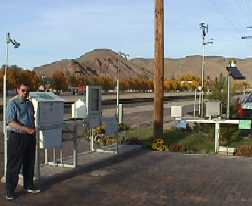
Brent Perkins
Community Environmental Monitor
Caliente, Nevada
The CEMS are local residents trained through attendance at regular workshops conducted by NNSA/NFO and DRI to understand the results of the environmental monitoring. They become knowledgeable on subjects ranging from radiation detection to local environmental conditions. This enables them to participate in public outreach, and to better answer questions from their communities about the monitoring program and data results in their area and throughout the network.
CEMs are effective technical liaisons between local and federal entities, helping to identify the environmental concerns of people in their communities. All members of the public are invited to visit the stations and see the data, which are also on the Internet on DRI's Western Regional Climate Center web site at http://www.cemp.dri.edu
Contact Information
For more information, write or call:
U.S. Department of EnergyNevada Operations Office
Office of Public Affairs and Information
P.O. Box 98518
Las Vegas, Nevada 89193-8518
Phone (702) 295-3521
Fax (702) 295-0154
E-mail: nevada@nnsa.doe.gov
http://nnss.gov
OR
Desert Research Institute
755 East Flamingo Road
Las Vegas, Nevada 89119
Phone (702) 862-5340
Fax (702) 862-5326
E-mail: Beverly.Parker@dri.edu
http://www.dri.edu

Beatty, Nevada - Community Environmental Monitoring Station
U.S. Department of Energy